Ipinapakita ang mga post na may etiketa na Philippines. Ipakita ang lahat ng mga post

Hunyo 14, 2012

Miagao Church

Baroque Romansque architecture
(c) ChingkyQuijano

It took a decade to build Miagao church, also known as Santo Tomas de Villanueva Parish Church. The construction began in 1787 under the supervision of Fray Francisco M. Gonzales O.S.A. and completed in 1797.

(c) ChingkyQuijano

The bas-relief facade features a large coconut tree that symbolizes as the "tree of life" in which St. Christopher is carrying the Child Jesus on his shoulders. I read that the Spanish missionaries selected this because for them, it embodies their mission to spread Christianity to other countries. The carvings also showed the traditions and life of Miagao residents.

Entrance door

The church was destroyed during the 1898 Revolution, damaged by fire in 1910, badly damaged by earthquake in 1948. It was subsequently rebuilt and the restoration work began in 1960 and ended in 1962.

(c) ChingkyQuijano

The church and its belfries or watchtowers served as fortress against raids by the Moros. 


That's why it is sometimes referred to as Miagao Fortress church since it sinks six meters deep into the ground with stone walls one-and-a-half meters thick and buttress thrice thicker in size for defensive purpose. 


Last summer I went for a tour around Ilocos Sur and Norte, when I saw Miagao church I remembered the Paoay church in Ilocos Norte. I told Mr. Noel, a lay minister/care taker of the church that Miagao church looks like San Agustin Church in Paoay, Ilocos Norte.  He answered that just like the church in Paoay, Miagao church is also one of the Baroque churches in the Philippines.


The church was declared as part of the UNESCO WORLD HERITAGE SITE "Baroque churches of the Philippines" in 1993.

(c) ChingkyQuijano

The Baroque architecture can be seen only in four churches in the Philippines, the other two are San Agustin church in Manila and Nuestra Señora de la Asuncion in Santa Maria in Ilocos Sur.


colorful collection bag -- ILIKE :)

The Miagao church was declared a national shrine by Presidential Decree No. 260 of former President Ferdinand Marcos.


Ilocos Sur Representative Imelda Marcos, Ferdinand's widow was said that she presented a painting of the Miagao church to the late Pope John Paul II making her an instrument of the church popularity.

Baptistery
(c) ChingkyQuijano


Mr. Noel opened the baptistery and allowed us to make a prayer-wish. *goosebumps*


Mother Mary image in Filipinia made of  pure wood.

According to Mr. Noel during the building of the church, the locals were asked to bring block of stones and eggs as their contribution. An egg yolk was used as binder. 

The white part is the "Apog" that is one of the original parts of the church since it was built.


Mr. Noel borrowed one of our cameras and repeatedly taking photos of Mother Mary. Then he showed us the photos and pointed out the Sacred Heart, Holy Trinity and angels images on the wall. *goose bumps* 

Scan the following five photos. 

(c) Chingky Quijano


Feel free to comment if you were able to see the images. 

with Mr. Noel, a lay minister/care taker of the church
He told us that his name, Noel is means "Christmas" in church, Noel means "no election" in politics but in Miagao Noel means "nothing excepts but love". 


 dated June 04 2012
Miagao, Iloilo
Philippines

Hunyo 11, 2012

Guimbal Church


Patterned with Baroque architecture
(c) ChingkyQuijano

Guimbal church or Parish of Santo Nicholas de Tolentino was one of the oldest church in the Philippines. The yellow sandstone churcn was built in 1774 by the supervision of Father Campos, a Spanish Priest.  It is made of adobe stones called igang and coral stones from Guimaras.


The belfry served as a watchtower during the Spanish occupation against Moro pirates. The church was destroyed twice, first during the World War II and during the 1984 earthquake. It has been reconstructed and was rehabilitated to its original edifice.


*The church was closed when we got there and weren't able to go inside


dated June 04 2012
Guimbal. Iloilo
Philippines

Molo Church


Exterior of Molo church. Famous for its Gothic-Renaissance architecture.
Molo church or Saint Anne Parish church was built in 1831 under the order of Fray Pablo Montano. The National Historical Institute declared the church as a national landmark in 1992.

A mixture of Gothic and Renaissance interior designs.
(c) ChingkyQuijano

The feast day of Saint Anne is celebrated every July 26 and her relics are exposed for veneration.

The altar got its Gothic features.

The church is the Feminist church in the Philippines due to the 16 statues of female saints placed on each column along the aisle that also serve as a mini altar for devotees.


Dr. Jose Rizal, Philippines National Hero dropped by the Molo church when he was on his way to Dapitan in August 1896. He was impressed with a biblical painting decorated on the church. Unfortunately, it cannot be seen on the church.


Belfry
I read that the church survived all calamities but not a bomb during a war on March 19, 1945.

The walls were made of white corral rocks.

A donated statue of Pedro Calunsod
I saw this statue and didn't taught that it was Pedro Calunsod. He was a native of the Visayas, a young migrant, student catechist, missionary and faithful collaborator. He will be canonized as the second Filipino saint at the Vatican on October 21, 2012. 


dated June 04, 2012
Jaro, Iloilo
Philippines

Hunyo 10, 2012

Villa Lizares

Lizares Mansion, a mixture of American and Spanish architecture.

The Lizares Mansion was built in 1937 by sugar barons of Iloilo, the Lizares family. This is one of Iloilo's most iconic heritage houses which is located in Tabuc Suba, Jaro, Iloilo city, specifically inside the Angelicum School of Iloilo (ASIL) campus.


During the World War II, the Japanese Army occupied the mansion and  it was believed that in the basement were reputed torture chambers where some Ilongo heroes were tortured and eventually killed and many Japanese soldiers also died. The place remained vacant for many years and rumored to be haunted. However in 1960s, it was leased to a businessman and turned it into a casino until it was closed.

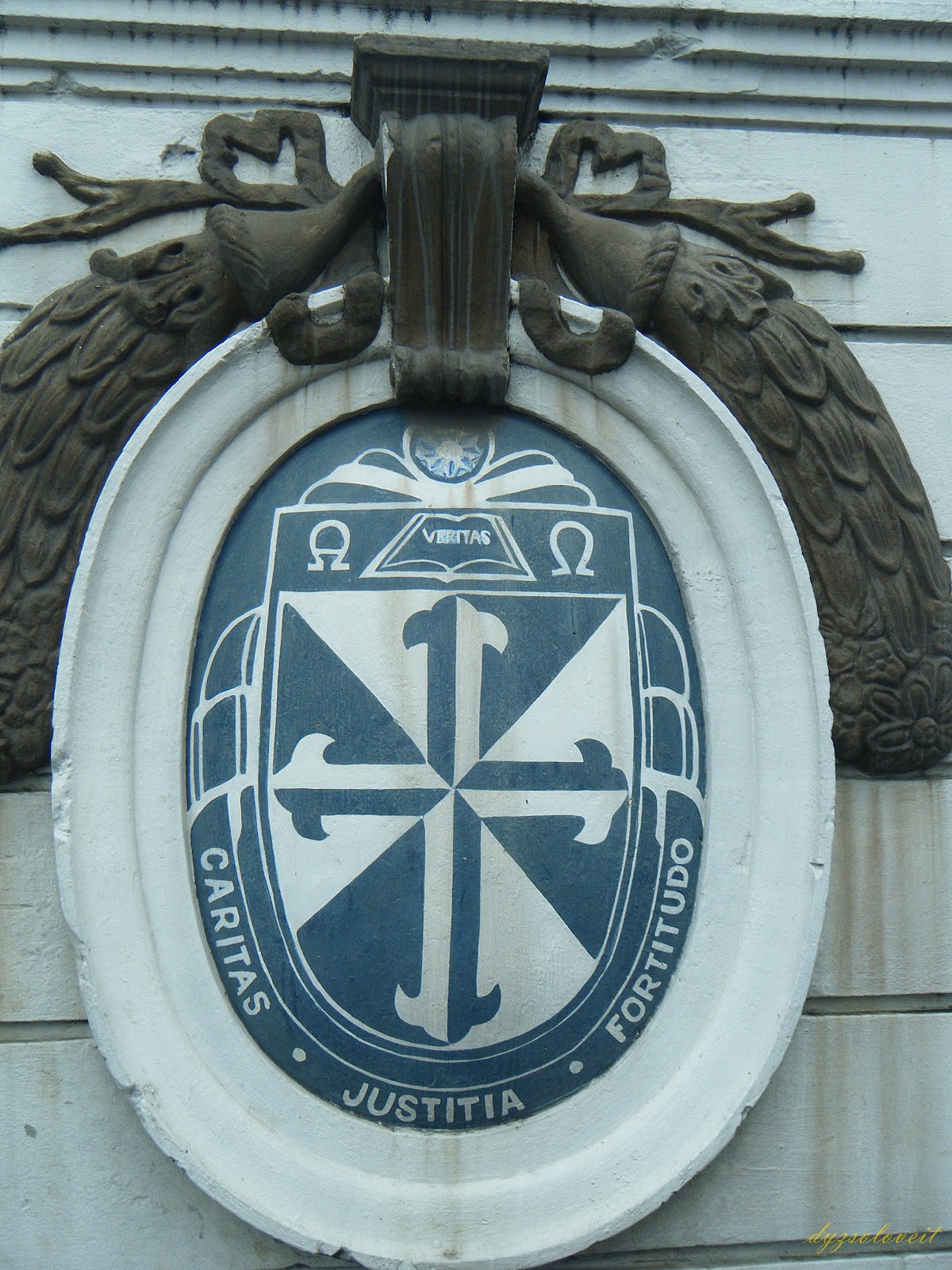
The Dominican Fathers bought the mansion in early 1980s (not really sure with the year) and they renovated it and became a house of formation, at the moment it is the ASIL chapel.


I read that the main building is lit up during Christmas season that makes it a tourist attraction. 


dated June 04, 2012
Jaro, Iloilo
Philippines

Jaro Metropolitan Cathedral

The Jaro Cathedral in Iloilo was built in 1874 by the order of KGG. Mariano Cuertero, O.P., the first bishop of Jaro. In January 1948 it was destroyed by an earthquake. It was repaired in 1956 by the order of the first archbishop of Jaro, KGG. Jose Ma. Cuenco.

Exterior of Jaro Cathedral
(c) ChingkyQuijano

Today, the cathedral is also known as the Nuestra Señora de la Candelaria 
(Our Lady of Candles).

Interior of Jaro Cathedral
(c) ChingkyQuijano

In 1976, the National Historical Institute proclaimed the Jaro Cathedral as a historical landmark.

Altar
(c) ChingkyQuijano

Baptismal service area
(c) ChingkyQuijano


Jaro Fiesta is annually celebrated every February 2 and it is said that it would last for more than a month or two. Month looooooOooooOong celebration...
HAPPY FIESTA! :)


Speaking of baptism...

Graciano Lopez Jaena 
(1856-1896) 
was baptized in this cathedral on December 20, 1856. He is a Filipino journalist, orator and revolutionary hero from Iloilo, well known for his written work, La Solidaridad. 


During the Pastoral Journey to the Philippines of Pope John Paul II, he made a visit to Iloilo on February 20 1981 to address the Laity from this balcony of the Jaro Metropolitan Cathedral and crowned solemnly the Divine Infant and Nuestra  Señora de la Candelaria amidst an undreamed of rejoicing of the people.


On April 21, 1982 Pope John Paul II proclaimed Nuestra  Señora  de la Candelaria Patroness of the Western Visayas. 

The statue of Our Lady of Candles is carrying a lighted candle on her right hand and a child on the other. It is located on the façade of the Cathedral and may be reach through a staircase on each side.

It is believed that she brings protection and divine illumination to one’s path if the person asks for her help.
These candles have prayers praising, thanking and asking guidance from Our Lady of Candles.

Lightning of candles on the balcony is prohibited for safety purposes instead there are lighting areas located inside the cathedral and on each side of the entrance.

Belfry of Jaro Cathedral
Historically, this 19th century bell tower served as a lookout from sea raiders.


There are also a Jesus Christ monument and Mother Mary monument placed infront of the cathedral which were both inaugurated in February 1925.


The walls were built of white and cream colored fossil rock and coral stones. Its exterior is baroque that also includes some neogothic and neoclassic elements.


dated June 04, 2012
Jaro, Iloilo
Philippines

Museo Iloilo


Museo Iloilo showcases the Ilongos' culture and history with its various collections of archeological, historical, ethnographical craft and tribal folk arts.


The museum was designed by Ilongo architect Sergio Penasales.


Museo Iloilo logo
It is currently administered by Iloilo Cultural Research Foundation Inc. which aims to sustain and develop cultural education, research and tourism through preservation and display of Western Visayas native culture and history. 


The public museum is located in Bonifacio Drive, Iloilo City. It is meters away from the Iloilo Provincial Capitol and the Iloilo's Department of Tourism office. 


Admission Fee
Student - Php 15 (w/I.D.)
Adult - Php 25


Museum Hours
Mondays-Saturdays 
9AM-5PM 
(Except for regular holidays)

Artifacts are located. Taking of photos are prohibited.
(c)ChingkyQuijano

This is the main display of the museum that exhibits mixtures of stone age native pottery; fossils; jewelry; burial jars and coffins and gold ornaments; stone age tools; trade pottery and jars from China, Annam and Siam; era photos; weaponries and armories of the Filipino-Spanish War in late 1800th cent and mementos from the 2nd World War; dioramas showing the simple life of the Ilongos before modernization arrived; old weaving loom; Hispanic-Filipino Era sculptures and religious statues, artifacts, images.


Ilongos who are passionate about their province's rich history donated some of the relics and antiques found in the gallery. 


Art Gallery. Taking of photos are allowed.
(c)ChingkyQuijano
The museum also shows modern art done by Ilongo artists and painters.


These souvenirs were made by local artists and craftsmen.
Souvenirs Shop

Museo Iloilo Rules
1. No food and drinks allowed inside.
2. Refrain from handling exhibit items.
3. Taking photographs inside the museum is strictly prohibited. Fine for taking photo(s) is Php 500.00

   
Museo Iloilo and on the left side is Iloilo Provincial Capitol
(c)ChingkyQuijano


Maybe you're asking why does taking of pictures inside museums are prohibited or you may be allowed but without flash? According to a tour guide in Negros photography inside museums or on paintings are prohibited because...
  • it may damage the quality of the paintings or artifacts especially when there is flash. These paintings or artifacts can't stand that much exposure to blinding bursts of light. 
1 click of camera with flash is equal to 
3 days exposure of the painting or artifact to the sun. 
  • security purposes

I also read that it can...
  • be a form of stealing money from the museum: art organizations and museum stores are suffering. Taking of a photo of a painting or an artifact means you won't buy a postcard or souvenir. ***I also think that there's a chance that once a future tourist saw your photos s/he may change his/her mind and not visit the museum that can affect the museum admission. Does I make sense here? hehe. ;)   
  • you're setting a bad example for future generations: the younger generation don't appreciate art that much so it is our task to be an example and to make them understand that these things are delicate objects to be protected.
  • you're damaging artists' claims to their intellectual property


if you want to learn about Iloilo: 
the heart of the Philippines 
come and visit Museo Iloilo. 
It is a venue where they span everybody's own vacancy.

dyzsolove...museo iloilo


dated June  04, 2012
Iloilo City, Iloilo
Philippines